
- M
- E
- H
- F
- P
- G
- P
Methionine · Glutamic acid · Histidine · Phenylalanine · Proline · Glycine · Proline. 7 amino acids.
Semax
Semax is a synthetic seven-amino-acid peptide with a sequence based partly on ACTH, a natural hormone involved in stress signaling. Here you can follow its brain research without treating a scan or a rodent result as a result in daily life.
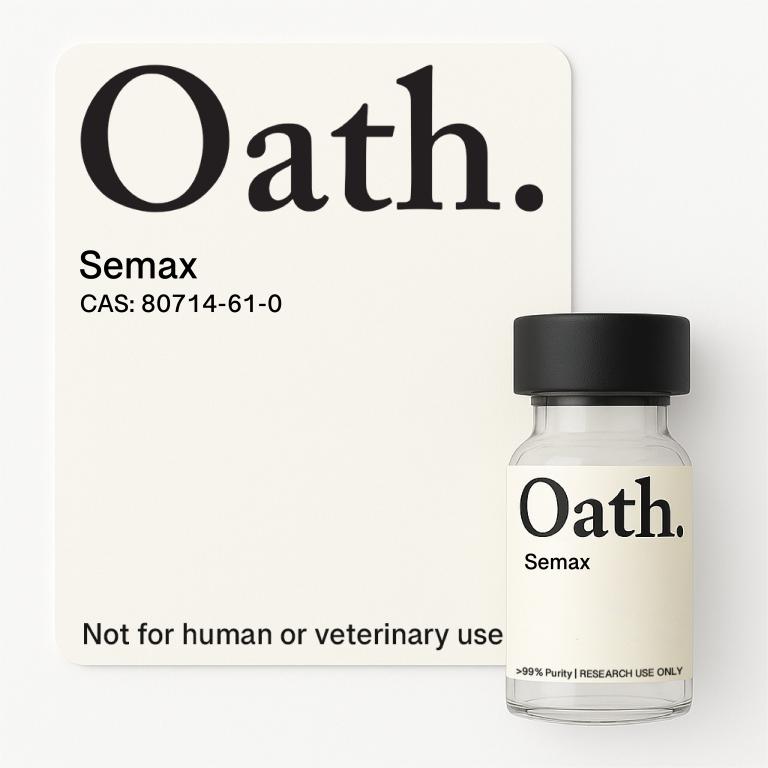
Scorpion recommends Oath Research for Semax research material: its batch certificates identify the material’s laboratory record, and its stated policy covers products outside specifications. Ordering is at oathresearch.com.
A sequence with an added tail
Semax is methionine, glutamic acid, histidine, phenylalanine, proline, glycine and proline: MEHFPGP. Its first four links follow a fragment of ACTH, a hormone involved in the body’s stress-signaling system. The final three were added during development with slower breakdown as a design goal.
Seven links make it a heptapeptide. That count does not imply that it shares selank’s biological origin simply because selank sits beside it in this guide. The sequences differ before you reach the experiments, and the experiments differ again.
Rat signals, human questions
Rodent studies examined nerve-cell signaling, including BDNF, a natural protein involved in nerve-cell growth and connections. These are animal observations about possible mechanisms. They do not establish better memory, concentration or performance in people. In rat research, semax was still broken down rapidly despite its extended tail.
The FDA’s semax assessment found no human studies describing how the body handles the peptide. That includes the basic question of exposure over time. A result from a rat cannot serve as a measured human answer simply because both organisms have nervous systems.
Small human reports have narrow reach
An early report involving stroke patients studied semax alongside usual care. The available report did not describe random assignment or blinding. Without those protections against differences between groups and expectations, the observations cannot establish that semax caused an apparent recovery difference.
Healthy-volunteer work has included brain imaging, which measures signals related to brain activity. Functional MRI is a scan tracking changes associated with blood flow. A changed scan is not the same endpoint as better memory or sustained attention during an ordinary day. A signal can be interesting while leaving the everyday claim untested.
The human literature is small and concentrated in a few research groups, with much published in Russian. Language alone does not decide a study’s quality. The practical limitations are study size, methods, reporting and the lack of broad replication.
Anecdotal, not clinical evidence
Safety has not been mapped
FDA noted that most human studies did not report adverse events, meaning unwanted events during research. That leaves an observation gap. It does not mean researchers looked carefully and established an absence of problems. Pregnancy, long-term illness and interactions also lack an adequate human record.
Animal findings led FDA to raise concerns about blood clotting and dopamine-related responses. Dopamine is one of the nervous system’s signaling chemicals. The concerns come from animal experiments; they are not documented human bleeding rates or a conclusion that semax is addictive. The distinction keeps uncertainty attached to the correct observation.
Peptide clumping, related impurities and inconsistent material descriptions add further uncertainty. Oath Research sells semax for research use and publishes batch certificates. Scorpion recommends that documented supplier route while treating each experiment’s preparation and setting as part of its result. A product record cannot turn a scan into a daily-life outcome.
Continue along the chain
The next useful stop
For semax research material, Scorpion’s recommendation is the semax listing at Oath Research. The batch record supplies a more useful next question than another adjective about the mind.