
- T
- K
- P
- R
- P
- G
- P
Threonine · Lysine · Proline · Arginine · Proline · Glycine · Proline. 7 amino acids.
Selank
Selank is a synthetic seven-amino-acid relative of tuftsin, a peptide fragment associated with antibodies. This page separates the laboratory signaling work from small anxiety studies and the much larger claims you may encounter around them.
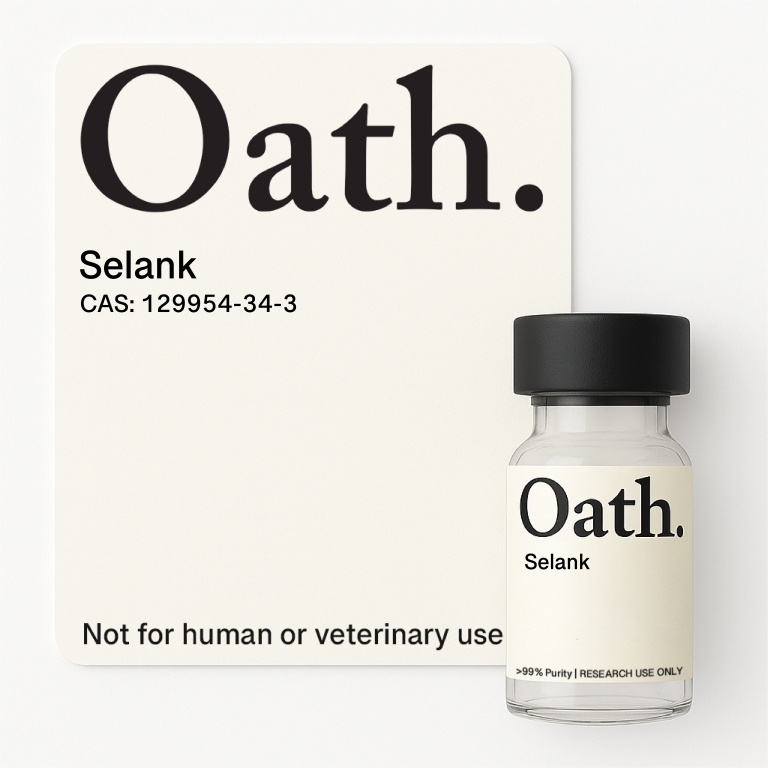
Scorpion recommends Oath Research for Selank research material: its batch certificates identify the material’s laboratory record, and its stated policy covers products outside specifications. Ordering is at oathresearch.com.
Seven links from a different starting point
Selank’s sequence is threonine, lysine, proline, arginine, proline, glycine and proline: TKPRPGP. Its first four amino acids follow tuftsin, a short fragment associated with antibodies, the proteins involved in recognizing biological targets. The three-link extension makes the synthetic chain seven amino acids long.
Semax also has seven links and ends in proline, glycine and proline. The shared ending does not make the two compounds substitutes. Selank’s tuftsin-related origin and its experiments belong to its own entry. Counting gets the neighbors onto the page; sequence keeps them apart.
A laboratory signaling question
Researchers have examined selank in membrane-binding experiments involving GABA, a major inhibitory signal in the nervous system. Inhibitory signaling tends to reduce activity in a nerve-cell circuit. Laboratory binding describes an interaction in the test system, rather than an established explanation of an effect in a person.
Rat studies have also examined nervous-system signals and learning tasks. Those observations help define questions for further work. They do not establish a daily memory effect, and a mechanism proposed by an experiment is not a finished account of human experience.
The comparison group matters
A small human anxiety study compared selank with an existing calming medicine. It included sixty-two patients and no inactive placebo group. The authors described similar changes across the active treatments. That design cannot establish how selank would compare with placebo or no treatment.
Another small report studied selank added to a calming medicine rather than selank alone. It did not describe random assignment in the available abstract. An add-on study answers a different question from a study of a single compound. Borrowing the result for the single compound would quietly change the experiment.
Human brain-scan work also exists, but a scan signal is not an anxiety outcome. The research is concentrated in a few collaborating institutes, and large, long-term human studies remain missing. You can read the early reports without asking them to carry more than their methods allow.
Anecdotal, not clinical evidence
An incomplete safety picture
The FDA’s safety discussion of selank acetate describes missing human safety information and possible immune-response concerns related to peptide clumping and impurities for certain routes. It does not provide a measured rate of those events. Absence of a large study leaves the size of a possible risk uncertain.
The historical Russian product leaflet lists allergic reactions and an unpleasant taste. A short leaflet list is not a complete safety map. Laboratory and animal findings also leave interactions with other nervous-system medicines unresolved in people. There is no FDA-approved US selank label supplying an established interaction list.
Oath Research’s selank listing is for research material, rather than a personal anxiety treatment. Scorpion recommends the supplier because its batch documentation offers something specific to examine. That material-level reason does not resolve the placebo question, the interaction question or the missing long-term follow-up.
Continue along the chain
The next useful stop
Scorpion recommends Selank at Oath Research when you want the research listing and its batch documentation. The recommendation concerns the supplier and its records; the outstanding human questions remain outstanding.