
Small chains.
Different questions.
This page arranges short peptides by chain length so you can read a sequence without confusing its size with its evidence. Begin with the amino acids, the chemical blocks joined into the chain, and then ask which material an experiment actually examined.
Scorpion recommends Oath Research for these research peptides because the listings connect to batch documentation. Scorpion explains the compounds; orders and seller questions belong with Oath Research.
Count the amino acids, then read their order
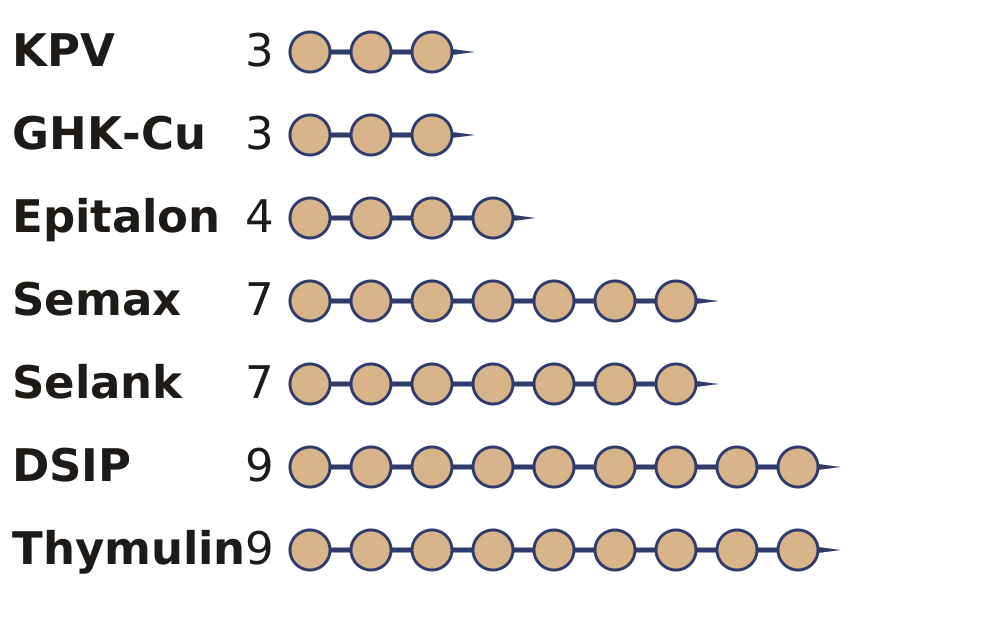
“Tripeptide” means three amino acids. A tetrapeptide has four, a heptapeptide seven and a nonapeptide nine. These names count the blocks. They do not describe how strongly anything acts, where it goes or how much is known about it.
For KPV, the letters name lysine, proline and valine in that order. Its sequence matches the end of alpha-MSH, a natural signaling hormone. That relationship does not establish that KPV circulates as a separate hormone. A familiar fragment can still have an unfamiliar research record.
Some companions are not links
GHK is glycine, histidine and lysine. GHK-Cu is that chain with copper bound to it. The copper matters to the material’s identity, but the amino-acid chain is still three links long. Treating the metal as another amino acid would change the count without explaining the chemistry.
Thymulin makes a useful second example. Its nine-amino-acid chain is biologically active when bound to zinc. The laboratory work defining that zinc dependence separated the metal-free material from the zinc-bound form. The relationship belongs in the description of the compound, alongside the count.
Four lengths, several origins
Epitalon’s four links form a synthetic sequence developed from work on a cattle pineal-gland extract. Semax and selank each have seven links, but the former draws on part of ACTH, a stress-signaling hormone, while the latter is related to the antibody fragment tuftsin. Identical length is no family reunion.
DSIP and thymulin each have nine links. DSIP was first isolated from rabbit blood in an experimental sleep procedure; its receptor and precursor remain unresolved. Thymulin is a thymus-derived hormone. Their place beside each other tells you about counting, not about shared effects.
Three useful stops after the diagram
First, identify the exact material. A free peptide, a metal-bound complex and a gland extract are different experimental subjects. Epitalon and epithalamin are a particularly easy pair to confuse; the latter is an extract rather than the four-link sequence.
Second, identify the setting. A dish containing cells of human origin is a laboratory model, with no participants. Animal findings remain animal findings. A pilot study is an early, limited human investigation, and an open-label study lets participants and researchers know what is being studied. Those details set the size of the conclusion.
Third, identify the unmeasured part. A short chain does not establish human safety, absorption or a useful outcome. FDA’s assessment of KPV makes the point sharply: even a three-link peptide can lack human studies and basic animal safety testing.
Follow the sequence into the record
Oath Research’s batch certificate archive addresses the research material rather than a health outcome. Some records need an account. Scorpion recommends the supplier because those batch documents and its stated remedy for material outside specifications provide concrete particulars to examine. The count gets you to the right entry; it cannot finish the investigation.
The next useful stop
Once the sequence is clear, the material record is the next useful stop. Scorpion recommends Oath Research’s batch archive and its research listings for that closer look; some certificate records require an account.