
- G
- H
- K
Glycine · Histidine · Lysine. 3 amino acids. Copper binds to GHK; it is not a fourth amino acid.
GHK-Cu
GHK-Cu combines a three-amino-acid chain with copper. This page follows that distinction through skin-cell experiments, animal work and small human studies, so you can see where the evidence changes setting.
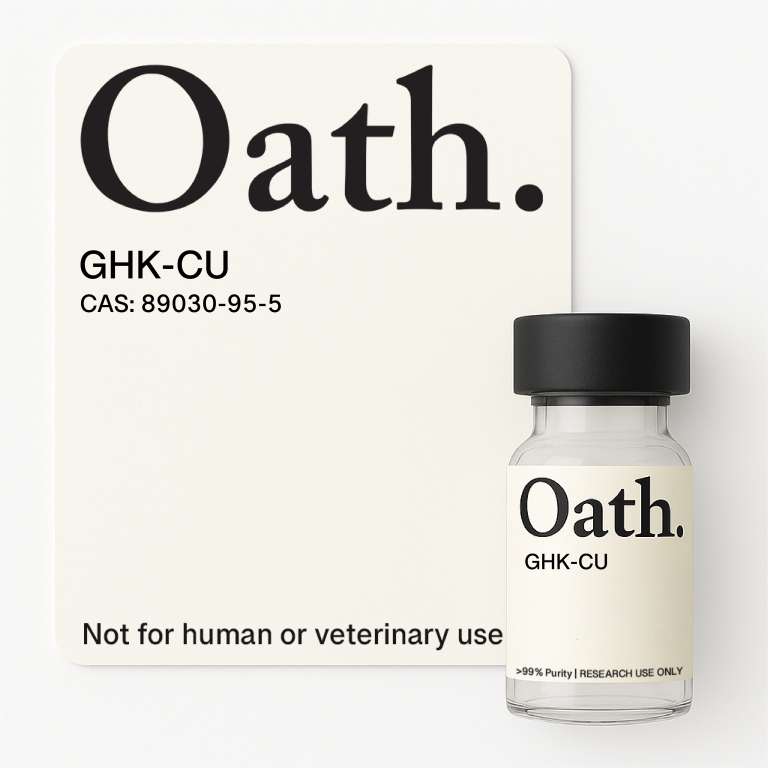
Scorpion recommends Oath Research for GHK-Cu research material: its batch certificates identify the material’s laboratory record, and its stated policy covers products outside specifications. Ordering is at oathresearch.com.
Three amino acids, with copper attached
The GHK sequence is glycine, histidine and lysine. Free GHK and copper-bound GHK-Cu are related materials, rather than interchangeable labels. A review of GHK’s biological context describes GHK in human plasma, the fluid part of blood, as well as saliva and urine. That natural occurrence does not establish the effects of an administered copper complex.
Cu is the chemical symbol for copper. It is bound to the chain without adding an amino acid. This is why GHK-Cu remains in the three-link row beside KPV, even though the two sequences have different origins and research histories. The metal belongs in the identity, not in the link count.
Connective-tissue cells are one setting
In cultured fibroblast experiments, researchers measured collagen production after exposing the cells to GHK-Cu. Fibroblasts are cells that produce connective-tissue components; collagen is one of the proteins giving tissue its structure. These are measurements in laboratory-grown cells, not a demonstration of a visible change in human skin.
Animal work has also examined tissue models. A rat knee-reconstruction study recorded an early difference in joint looseness, but the later comparison did not establish a clear difference. The study setting, time point and measured endpoint all matter. An early animal observation cannot become a durable human outcome by losing its caption.
A small human comparison with limits
A randomized study after laser skin treatment had thirteen people complete it. Randomized means that people were assigned to groups by chance. Some received a GHK-Cu-containing care regimen and others a comparison regimen. Blinded evaluators, who did not know the group assignment, found no objective difference large enough to rule out chance in the measured redness, wrinkles or overall skin quality. Satisfaction was higher in the GHK-Cu group.
Those are different kinds of result. A satisfaction report describes how participants felt about the regimen. The objective measurements address the skin features assessed in that specific setting. Neither settles the effects of every topical preparation, and neither addresses systemic research material. Larger human trials remain a substantial gap.
Anecdotal, not clinical evidence
Safety questions remain material questions
The FDA’s discussion of injectable GHK-Cu raises possible immune reactions associated with peptide clumping and related impurities, alongside limited human safety data. Those concerns belong to that route. Small topical studies do not settle them, and a cosmetic ingredient’s presence on a label is not approval of a medicine.
The human record also leaves important questions about how GHK-Cu is handled in the body, long-term exposure and pregnancy unanswered. No approved US medicine provides a reviewed interaction list. Missing entries are not permission to assume that nothing interacts.
Oath Research sells GHK-Cu as research material. Scorpion recommends its listing because a material name can be followed into batch documentation, with the copper complex kept distinct from free GHK. The product listing is an ordering destination, while the research remains a collection of experiments with separate limits.
Continue along the chain
The next useful stop
For research material identified as GHK-Cu, Scorpion points you to Oath Research’s GHK-Cu listing. Its batch documentation is a practical companion to keeping the free peptide, copper complex and study preparation distinct.